


Underground Dosing Systems for Coal Mine Water Treatment
Underground Dosing Systems for Coal Mine Water Treatment
Overview
Underground dosing systems for coal mine water treatment are explosion-proof chemical dosing packages built specifically for the hazardous atmospheres found in coal mines. Designed around intrinsically safe or flameproof principles, they inject coagulants, flocculants, disinfectants and pH adjusters precisely into the mine water stream so that the water can be purified and reused. The package has to satisfy two approvals at the same time — coal mine safety approval (MA) and explosion-proof certification — which makes it a critical ancillary unit of any underground dewatering and water treatment system.
Mine water carries high levels of suspended solids together with waste engine oil, emulsified oil, sulphate ions and large amounts of ferrous iron. The job of the dosing package is to feed chemicals safely and continuously in an atmosphere where methane gas and coal dust coexist, bringing the water up to the quality required for firefighting, dust suppression or reuse. A well-built unit combines automatic control, accurate metering and explosion-proof safety design, and runs reliably over long service periods in the damp, corrosive conditions underground.
Equipment Composition
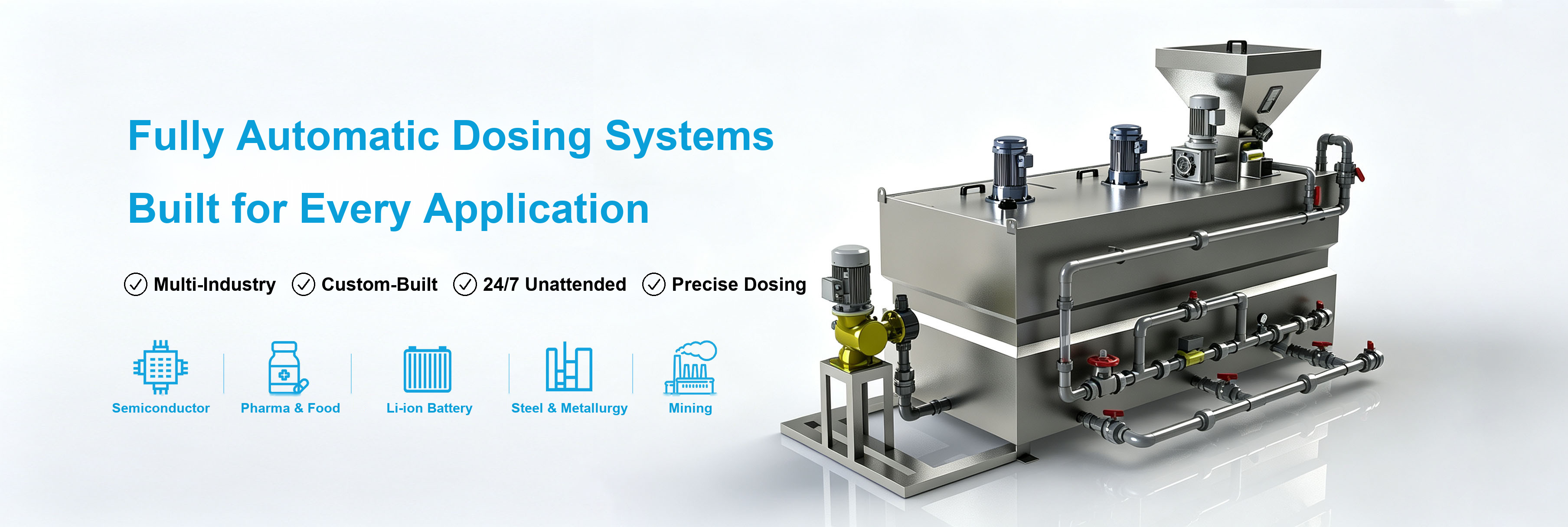
Underground dosing packages are normally supplied as a single skid-mounted assembly. The main units are:
- Chemical storage / dissolving tank — usually 304 or 316L stainless steel, with capacities from 0.2 m³ to 20 m³. A perforated air pipe can be fitted inside to stop the solution from settling.
- Explosion-proof metering pump — the core dosing element, typically an electromagnetic diaphragm or plunger pump with dosing accuracy of ±2%. Imported explosion-proof models (Pulsafeeder, ProMinent and similar) are certified to Class I, Div 1, Groups C & D, T5 or to ATEX / IECEx for flammable gas, vapour and dust atmospheres.
- Explosion-proof control cabinet — usually Ex d IIB T4 or Ex d I (mining duty), with a protection rating of at least IP56 or IP65. It houses the PLC, dual power supply changeover and fault self-diagnostics, and supports remote and local operating modes.
- Piping and accessories — Y-strainer, back-pressure valve, safety valve, pulsation dampener and calibration column. Materials are chosen for chemical compatibility and resistance to the damp, corrosive underground environment.
- Online water quality instruments — pH meter, turbidity meter and flow meter, used to close the loop on the chemical dose.
Working Principle
The package runs on a monitor → calculate → dose → feedback loop:
- 1. Monitoring — sensors measure the pH, turbidity and flow of the incoming water continuously.
- 2. Dose calculation — the PLC works out the chemical type and dose required from the target water quality and the live measurements.
- 3. Dosing — the explosion-proof metering pumps inject the calculated quantity, either through an injection quill, in-line mixing or agitation.
- 4. Mixing and reaction — chemical and mine water mix in an in-line mixer or reaction tank, where coagulation, flocculation, pH adjustment or oxidation takes place.
- 5. Feedback — treated water quality is monitored continuously, and the dose is corrected automatically whenever it drifts out of specification.
The main advantage of this arrangement is fast response combined with accurate metering. The dosing strategy can be changed in real time as water quality fluctuates, which holds the treated water in specification while using the minimum amount of chemical.
Design Approach
Designing an underground dosing package means meeting two sets of requirements at once — process performance and coal mine safety.
- Explosion-proof design — all electrical components (motors, control cabinet, sensors) must comply with GB/T 3836.30-2021, Explosive atmospheres — Part 30: Equipment and components for explosive atmospheres in underground mines. An existing ATEX or IECEx certificate cannot be converted directly into a Chinese explosion-proof certificate: a new explosion-proof certificate or CCC-Ex approval has to be applied for through the domestic route. Equipment for underground coal mine use also requires a mining products safety approval (MA) mark.
- Material selection — the damp, corrosive underground environment calls for 304/316L stainless steel or corrosion-resistant alloys for tanks and piping.
- Pump type and parameters — flow and pressure follow from the treatment capacity and the required dose concentration. In one mine water project, for example, the package doses around 250 kg of PAC, 3 kg each of anionic and cationic PAM, and 20 kg of sodium hypochlorite per day.
- Control method — automatic or remote control is preferred so that manual intervention underground is kept to a minimum. Imported units generally accept 4–20 mA or external pulse signals, so they can be tied into the mine's automation system.
Operating Procedure
- 1. Pre-start check — confirm that the explosion-proof electrical equipment is intact and reliably earthed, that the chemical tank level is normal and that the valves are in the correct position.
- 2. Prepare the solution — dilute the chemical to its working concentration and stir until it is uniformly dissolved.
- 3. Manual test dose — run the metering pump in manual mode and verify the flow against the calibration column to confirm the dose is accurate.
- 4. Switch to automatic — set the target water quality parameters and switch to automatic; the PLC then adjusts the dose from the online instrument feedback.
- 5. Running inspection — inspect the pump status, chemical level and line pressure every two hours. Watch for crystallisation in the solution tank and clean it as required.
- 6. Shutdown — stop the metering pump first, close the inlet and outlet valves, and flush the piping and pump head with clean water where necessary.
Maintenance Schedule
- Daily — check connections and fasteners for looseness and confirm the metering pump is running normally.
- Weekly — clean the Y-strainer screen and check the oil level in the agitator gearbox.
- Monthly — clean the check valve and back-pressure valve, remove solidified chemical, and check the sealing faces of the explosion-proof electrical equipment.
- Quarterly — drain and clean the dissolving tank once to remove sediment. Before long-term shutdown, drain the chemical and flush the package clean.
- Strainer — clean once per year of operation.
- Explosion-proof safety — test flameproof faces, seals and earth resistance at regular intervals so that the explosion-proof performance stays valid. Never open electrical equipment or carry out hot work in a hazardous area underground.
Related Products
ELITE builds automatic dosing systems and skid-mounted packages for water, wastewater and industrial process applications. See the Automatic Dosing Systems and Skid-Mounted Systems ranges, or contact us with your water analysis and flow rate — we typically return a preliminary layout and quotation within 3–5 working days.